
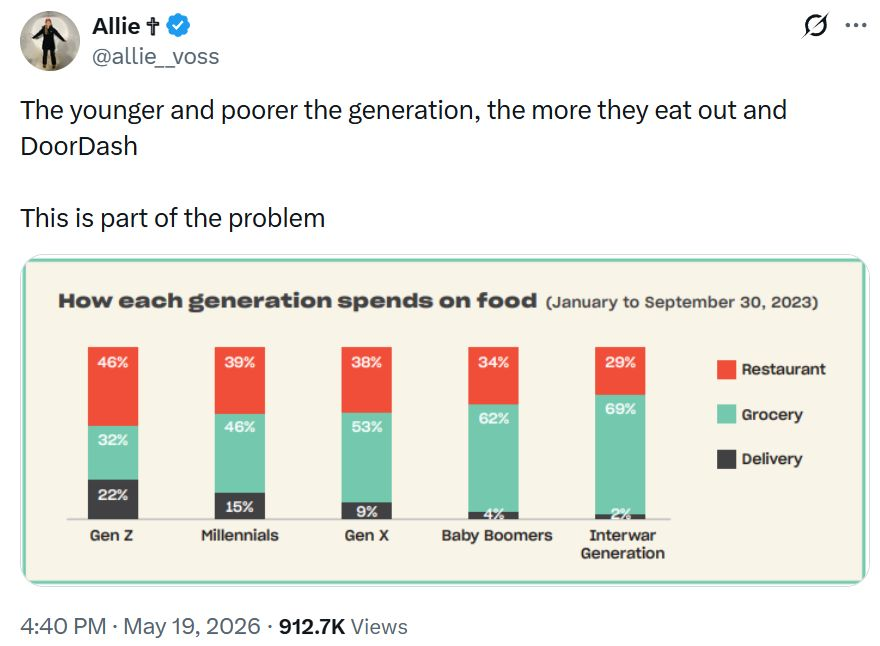
A chart (below) went viral recently showing how each generation spends on food. The younger the generation, the more goes to restaurants and delivery, and the less to groceries. The take attached to it was blunt: younger, poorer people order out more, and that is part of the problem. The question worth asking is why younger generations order out instead of cooking, and the honest answer has more to do with time and money than character.
I pushed back, and the post took off on LinkedIn. You can read the original post and the full comment thread here. What followed in the comments turned into one of the more honest snapshots of where workers actually sit right now. I want to walk through the argument, then show you what hundreds of people added to it, because the response is the real story.
What I Actually Said
For the record, I mostly cook and barely order in, so I was not coming at this defensively. My issue is that the chart, and the countless takes like it, overlook a lot while spotlighting some genuinely skewed thinking.
Most workers do not have time to eat, much less prepare a meal. Look at what a normal day runs for a huge share of Americans:
- Most have no time to cook, sometimes even stop for breakfast.
- Lunch breaks get skipped constantly, and plenty of people wear that as a badge of honor.
- A two-hour daily commute time is normal for a large chunk of the workforce.
Who has the energy to cook after getting home at 7, 8 or later and still tend to the rest of their life? People want to frame this as a money-management issue when it is really about shrinking free time stacked on top of rising financial stress. I am about to turn 40, and I know plenty of people my age and older living the same squeeze. This stretches well past Gen Z and Millennials.
We were promised that technology would give us more time. Fewer hours, more freedom, a better quality of life. The expectation flipped: work more, save money while costs rise, and find time to cook instead of ordering in.
We are drifting toward a 24/7 work culture where wages are not matching what gets asked of people, and we have already seen how dangerous that gets in the at-desk deaths reported in places like China and Japan. Ordering in is a symptom of a long-simmering systemic problem. I am all for addressing it. Telling people to cook more will not fix it.
The Data Behind the Systemic Time Crunch
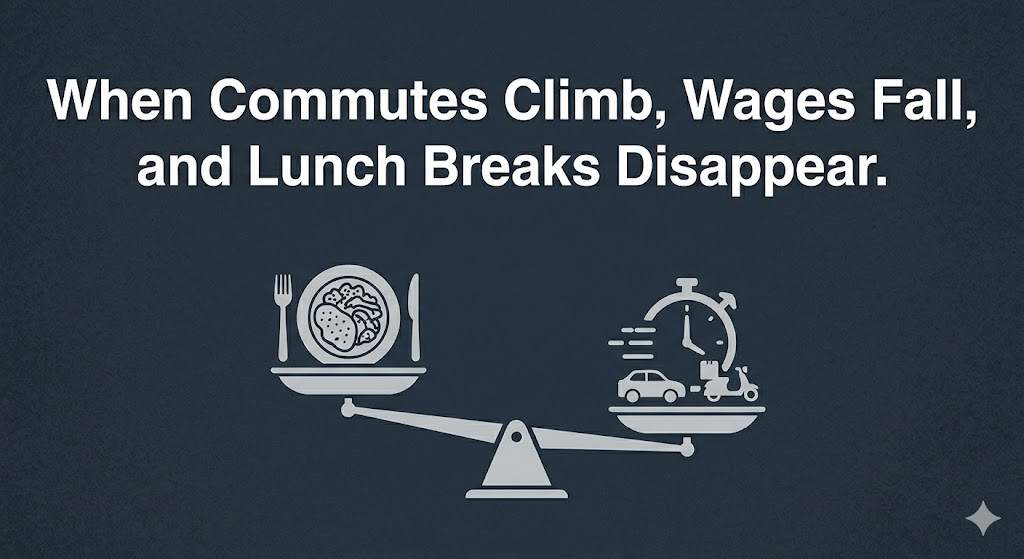
The viral chart focused one behavior and little to nothing behind it. In reality, there is data to show how Americans operate today. A few numbers stand out:
- The average one-way commute time reached over 27 minutes in 2024. That’s a near all-time high, according to the U.S. Census Bureau.
- 55% of employed Americans skip lunch breaks on busy days. And anecdotally speaking, a lot of folks wear that like a badge of honor.
- The typical worker earns about 1.2 percentage points below the rise in the cost of living over the past four years, per Bankrate.
- Ordering delivery costs roughly 80% more than picking up the same meal, a LendingTree study found.
Commutes keep climbing. The average one-way trip to work hit a record 27.6 minutes in 2019, and after a brief pandemic dip it climbed back to 27.2 minutes by 2024, according to U.S. Census Bureau data. That is nearly an hour round trip on average, and 9.3% of workers logged one-way commutes of 60 minutes or more in 2024, up from 8.9% the year before. Bus commuters alone average 46.6 minutes each way.
Lunch breaks are going away. As mentioned above, a 2025 Talker Research survey found that 55% of working Americans skip lunch when busy. Additionally, the analysis found that the average worker forgets to have lunch two times a week. And when they do eat, a third do it at their desk. Additional ezCater research found that more than one-third of Gen Z and Millennial employees claim that a manager makes them feel they can’t take a lunch break.
Add to the fact that pay isn’t keeping up. Today, the average worker earns about 1.2% lower than the rising cost of living over the past four years. That figure comes from Bankrate’s 2025 Wage to Inflation Index.
In short, longer days, vanishing breaks, and subpar pay are rampant in an environment where people are being told to just cook their way out of.
Reality in the Comments Section
My LinkedIn thread saw comments from operators, payroll specialists, HR leaders, journalists and consultants, among others. Among them, a few themes kept coming to light.
Time Is a Resource Nobody Gets Back
Eric Rosa, a lab and operations professional, replied to a commentor who blamed the issue on video games rather than what I felt was the issue. Rosa explained that he had lived across the spectrum of means, including eating rice and beans for so many days straight that he couldn’t stand them for many years after.
Rosa replied stating that, “We are selling to Gen Z and younger that if you just spend every moment of your time either working or performing household labor you can be healthy enough to enjoy…working and household labor.”
He added, “It’s no mystery why people feel distressed by that.”
Ivy Smith, a payroll professional, also replied to the thread, adding, “You can’t value your way out of a true capacity problem.”
The Invisible Labor of Meal Prep and Household Upkeep
The times have changed. Jessica Cole, a talent acquisition professional, commented that the chart lacked historical context. She noted that most heads of household in older generations had a stay-at-home spouse doing the cooking and cleaning, typically affording those households more home-cooked meals.
Smith drove her point home by speaking to the undervalued impact of women. The numbers back up her claim, and they have not gone away with time. Data from the Bureau of Labor Statistics 2024 American Time Use Survey found that women still spend more time on household activities than men.
Furthermore, according to the Gender Equity Policy Institute, women who work full time reportedly handle 1.8 times as much household work as men who work full time. That totals to 9.7 hours a week of household work against 5.4. These numbers appear to holds in homes without children. That is the labor the chart simply categorizes as “groceries” and home cooking.
Regardless of gender, counting today’s home-cooked meals as a virtue while disregarding the hours behind them overlooks the individuals putting in the sweat equity, often after a day of work and commuting.
Cooking Is More Than the Cooking
Carrie Miller, a senior consultant, named what the chart flattens. It is not just the time to cook. It is the planning, the grocery list, the shopping, putting everything away and the cognitive overhead of running it all, often alone.
The hours add up fast. Americans who prepare food average about 40 minutes a day on prep and cleanup alone, which works out to roughly 10 full days a year, according to BLS time-use data, and that figure leaves out shopping entirely. USDA-cited figures put grocery shopping at about 46 minutes per trip, more than a full week of time lost to it across a year. Add planning, and people who meal prep seriously report spending 7 to 14 hours a week on the whole operation.
She and others also named the guilt of tossing food that spoiled when any step slipped. When money and time are both tight, that loss stings more and happens more often. The chart shows a single line for groceries. It hides the entire job behind it.
The System Built the Trap, Then Billed for It
Ashley S., an MBA candidate at UCLA Anderson, tied it together. Corporations and weak regulation created conditions that work people to exhaustion, then sold those same people a delivery solution, charged steep fees for it and turned around to blame them for using it.
The fee math proves her point. A 2025 LendingTree study found that ordering delivery costs 79.5% more than picking up the same meal, an extra $9.30 per order on average, even as about 40 percent of Americans order delivery at least once a week. A separate Self Financial analysis clocked DoorDash at 71% above restaurant prices for the same food. The exhaustion is manufactured upstream. The premium for relief gets charged downstream, to the same worn-out people.
Amanda Robelly, a technical writer who brought lunch from home and still ate it at her desk while working through the break, added the newest pressure point: AI-driven layoffs landing alongside record profits, return-to-office mandates, longer commutes and less free time.
Aaron Cash, an operations and systems manager, gave the line I would put on the wall. If your response to an employee saying they cannot afford to eat is to tell them to skip the coffee and the takeout, you are not hearing what they are telling you.
The Pushback, and What It Missed
Two kinds of disagreement showed up. Both are worth naming, because they reveal how these viral charts work.
The first camp argued the data itself. Smart people pointed out that the chart hides the absolute dollars, never says how many mouths each household feeds, ignores that the oldest cohort is 80 to 98 years old, and strips out any cost or regional context. They are right on the merits.
Here is the catch: that critique answers a question I did not ask. My post was never a defense of the chart’s accuracy. It was about the conclusion people were stapling to it. The data-flaw camp and I were arguing past each other, and that is worth flagging on its own.
These viral posts tend to cherry-pick or omit data exactly like this, on purpose, to spark a fight, farm engagement or prop up a shaky hypothesis. A clean chart does not go viral. A chart with a finger on the scale and a moral attached to it does.
The second camp argued the behavior. Their position: people make time for what matters, cooking included, and the real gap is that younger generations were never taught to cook, do not grasp how food quality affects health and spend too long in front of screens. There is a real kernel there, and I said so in the thread. Cooking skills and food education matter.
Where it breaks down is the leap from “make time for what’s important” to “anyone who orders in is mismanaging time they actually have.” That assumes the time exists and is being squandered. For a parent commuting two hours, working irregular shifts and caretaking at night, the time is not hiding behind a video game. It is not there.
What struck me is that several people made my case better than I did while trying to argue against it. The “just make time” line kept leaning on a stereotype of a young person gaming instead of cooking, while the real people in the thread were describing three jobs, single parenthood, chronic illness and skipped lunches. When the answer to a capacity problem is a character judgment, the capacity problem is usually real.
Blaming Gen Z for Takeout Isn’t It
Affordability and education are the levers worth pulling. Make quality ingredients more accessible. Teach people to cook in ways that fit real schedules. I am fully on board with both. What I will not accept is the framing that treats ordering in as a moral failure rather than a rational response to a system that keeps taking time and stability away from working people. The chart caught a symptom. The conversation in those comments caught the disease.
Want to read more about the importance of work-life balance and other modern workplace essentials? Head to the AWARD blog for more.