
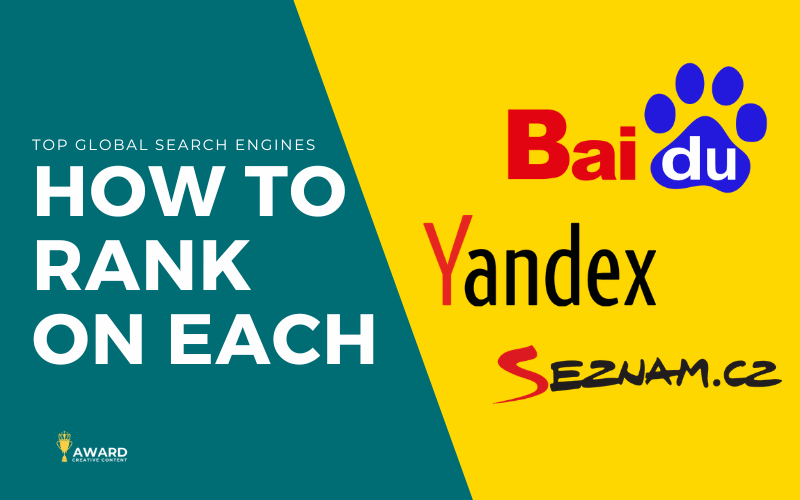
What are the most important international search engines in the world today?
Google remains the dominant search platform globally, handling roughly 90 percent of worldwide search activity according to StatCounter data. However, several regional search engines still influence visibility in specific markets.
Major platforms include Google, Bing, Baidu in China, Yandex in Russia and surrounding regions, Naver in South Korea, and Seznam in the Czech Republic. Businesses targeting international audiences should understand how each platform indexes and ranks content.
What are the best search engines for international SEO?
For most businesses, the best search engines to focus on are Google and Bing because they cover the majority of global search traffic. Google dominates worldwide search while Bing still captures a meaningful share through Microsoft products and partnerships.
However, companies expanding into international markets may also need to consider Baidu, Yandex, Naver, or Seznam depending on the region they are targeting.
How do you rank for international SEO?
The foundation of ranking across different search engines is strong SEO fundamentals. This includes publishing helpful content, maintaining clear site architecture, ensuring fast page performance, and earning credible backlinks.
Most search engines rely on similar signals, although each platform may emphasize different ranking factors. Once core SEO practices are in place, businesses can adapt strategies for specific platforms such as Baidu or Yandex.
Why do some countries use different search engines?
Regional search engines often develop because of language differences, local internet ecosystems, and government regulations. For example, Baidu became the dominant search engine in China due to restrictions on Google services and strong local adoption.
Similarly, Yandex built its presence in Russia through localized technology designed for the Russian language and regional search behavior.
Understanding these ecosystems is important for companies expanding into international markets.
What is the best strategy for international SEO?
The most effective international SEO strategy starts with optimizing for Google since it dominates global search traffic. From there, businesses expanding into specific markets can adapt their approach for local search engines.
This may include publishing localized content, registering with regional webmaster tools, and adjusting technical SEO elements to meet each platform's indexing requirements.
Is SEO different for Google, Bing, Baidu and Yandex?
The core principles of SEO remain consistent across most Internet search engines. Search engines prioritize useful content, clear page structure, and trustworthy websites.
However, some ranking signals vary. For example, Bing tends to weigh traditional on page optimization more heavily, while Baidu often requires Mandarin content and regional hosting considerations. Yandex historically focused strongly on regional relevance and user behavior.
Businesses pursuing international visibility should combine strong Google SEO fundamentals with platform specific adjustments.
Learn more about the top U.S. internet search engines and how to rank.
Globally, Google remains the dominant domestic and international search engine by a wide margin. Google processes the vast majority of search queries worldwide, controlling roughly nine out of ten searches across the internet depending on device type and region, according to StatCounter’s global search market share data.
For most businesses, this means Google still sets the global standard for SEO strategy.
However, international search behavior is more nuanced than many marketers realize.
While Google dominates most markets across North America, Europe, and Latin America, several countries maintain strong regional search ecosystems where alternative search engines still influence visibility and rankings.
In other words, global SEO strategy usually falls into two tiers.
The first tier includes Google dominated markets, where Google controls over 90 percent of search traffic and optimizing for Google effectively covers most search visibility, again supported by StatCounter’s worldwide search engine market share reporting.
The second tier includes regional search ecosystems where alternative engines maintain meaningful influence. In these regions, businesses may need to adapt their search strategy to additional search platforms.
Some of the most notable examples include:
- Baidu in China, where local search behavior differs significantly from Western markets (China search market share)
- Yandex in Russia and nearby regions, which still holds meaningful search share locally (Russia search market share)
- Naver in South Korea, which operates more like a content portal than a traditional search engine (South Korea search market share)
- Seznam in the Czech Republic, one of the few European search engines still maintaining regional influence (Czech Republic search market share)
Each of these search engines operates with its own indexing systems, ranking signals, and webmaster tools.
For businesses pursuing international visibility, understanding how these engines rank content can make the difference between appearing in search results or disappearing entirely in certain markets.
How to improve your Global SEO rankings
Ranking internationally requires more than simply optimizing for Google. Different search engines prioritize different signals, indexing methods, and ecosystem features.
That said, the core principles of search remain consistent across most platforms.
Key foundations include:
- Publishing helpful, authoritative content aligned with Google Search Essentials guidelines
- Maintaining strong technical SEO and site performance following Google Search Central documentation
- Building credible backlinks and avoiding manipulative link tactics outlined in Bing Webmaster Guidelines
From there, businesses can layer on additional optimizations specific to regional search engines when expanding into those markets.
Top International Search Engines in the World
The foundation of search is optimizing for search engines where users actually search. Globally, several engines dominate search activity depending on the country or region.
Understanding how each platform ranks content can help businesses expand their visibility internationally.
Google (Global Leader)
Market Share and Importance
Google remains the most widely used search engine in the world. According to StatCounter Global Stats, Google consistently accounts for roughly 90 percent of global search activity across desktop and mobile devices.
Because of this dominance, Google effectively defines modern best practices.
Google Ranking Factors
Google uses hundreds of ranking signals to determine which pages appear in search results. While Google does not publish a weighted ranking formula, it outlines best practices through Google Search Essentials.
Some of the most influential areas to focus on include:
- High quality, original content that demonstrates expertise and trustworthiness
- A strong backlink profile from authoritative websites
- Technical performance such as page speed and mobile friendliness
- Proper indexing and crawlability
Google’s algorithm has evolved significantly in recent years. Rather than focusing only on keywords, the search engine now emphasizes intent, content depth, and user experience.
This means the pages that rank best are those that provide the most useful answer to a search query.
Google also prioritizes content aligned with E-E-A-T principles discussed within Google’s Search quality guidance.
Google SEO Best Practices
Businesses should follow Google Search Essentials when optimizing content.
Best practices include:
- Using descriptive page titles and headings with relevant keywords
- Structuring content clearly so search engines can interpret it
- Implementing schema and structured data using Google’s structured data documentation
- Creating authoritative content that demonstrates genuine expertise
- Earning backlinks from reputable websites
Ultimately, ranking well on Google requires publishing the most trustworthy and helpful content for a given query while ensuring the website performs well technically.
Bing
Market Share and Importance
Bing remains the second largest search platform globally. While it trails Google significantly, it still represents a meaningful share of global queries according to StatCounter search engine statistics.
Bing Ranking Factors
Bing evaluates many of the same signals as Google but tends to emphasize traditional on-page optimization factors outlined in Bing Webmaster Guidelines.
These include:
- Keyword placement in titles and headings
- Clear metadata and page descriptions
- Strong multimedia content such as images and videos
- Well structured HTML
Bing SEO Best Practices
Businesses can improve visibility on Bing by following Bing Webmaster Guidelines.
Key strategies include:
- Target keywords in titles, headings, and metadata
- Use structured data to help Bing interpret content
- Publish multimedia content such as optimized images and videos
- Verify websites through Bing Webmaster Tools
Submitting a website to Bing Webmaster Tools allows businesses to monitor indexing, diagnose crawl issues, and track search performance.
DuckDuckGo
DuckDuckGo remains a smaller but influential privacy-focused search option. It sources results from multiple providers while also operating its own crawler known as DuckDuckBot.
According to the official DuckDuckBot documentation, websites can ensure crawl access through standard robots.txt configuration.
DuckDuckGo SEO Best Practices
Because DuckDuckGo draws heavily from other search indexes, strong technical fundamentals remain essential.
Key strategies include:
- Ensure DuckDuckBot can crawl the site using robots.txt rules
- Maintain strong indexation foundations through engines like Bing
- Publish clear, helpful content that aligns with user intent
- Maintain healthy site architecture and internal linking
Baidu (China)
Baidu remains one of the most influential search engines in China. Because Google services are limited in mainland China, Baidu often becomes the primary gateway to search visibility for businesses targeting the Chinese market.
Baidu SEO Best Practices
Businesses looking to rank on Baidu should consider several key actions:
- Register websites through the Baidu Search Resource Platform (Ziyuan)
- Submit sitemaps and URLs for indexing within the platform
- Publish Mandarin Chinese content tailored to local audiences
- Ensure fast page loading for Chinese users
Yandex (Russia and Regional Markets)
Yandex remains a major search tool in Russia and neighboring regions. The company provides a full set of tools and documentation through Yandex Webmaster.
Yandex SEO Best Practices
Key strategies include:
- Verify websites through Yandex Webmaster Tools
- Submit sitemaps following Yandex sitemap documentation
- Monitor indexing and crawl diagnostics
- Maintain strong technical performance and regional relevance
Naver (South Korea)
Naver operates differently from Western search engines. It functions more like a content portal combining search results with its own content ecosystem.
Businesses can manage indexing and visibility through Naver Search Advisor.
Naver SEO Best Practices
Key strategies include:
- Register websites using Naver Search Advisor
- Follow the official Naver Webmaster Guide
- Publish Korean language content
- Maintain crawlable page structures
Seznam (Czech Republic)
Seznam remains an influential regional search engine in the Czech Republic.
The platform offers site diagnostics and verification tools through Seznam Webmaster.
Seznam SEO Best Practices
Key actions include:
- Verify domain ownership through Seznam Webmaster
- Monitor crawl data and indexing reports
- Maintain strong technical performance and site structure
Know Your Search Engines
Google remains the dominant engine across most of the world according to StatCounter global search market data.
However, international SEO success often requires understanding regional search ecosystems.
Baidu in China, Yandex in Russia, Naver in South Korea, and Seznam in the Czech Republic each play important roles within their respective markets.
Businesses pursuing international search visibility should combine strong Google search fundamentals with region specific optimization strategies.
More Helpful SEO Tips from AWARD CC
Looking for more insights on how to power your brand’s search strategy in 2026? Check out some of these recent blogs from AWARD.
Want help optimizing your brand or website? Contact AWARD Creative Content today. We have over 10 years experience optimizing and creating content for various industries, including YMYL sectors like cannabis.